Is Kenyan Theatre On The Decline?
By: ADMIN
23/02/2026
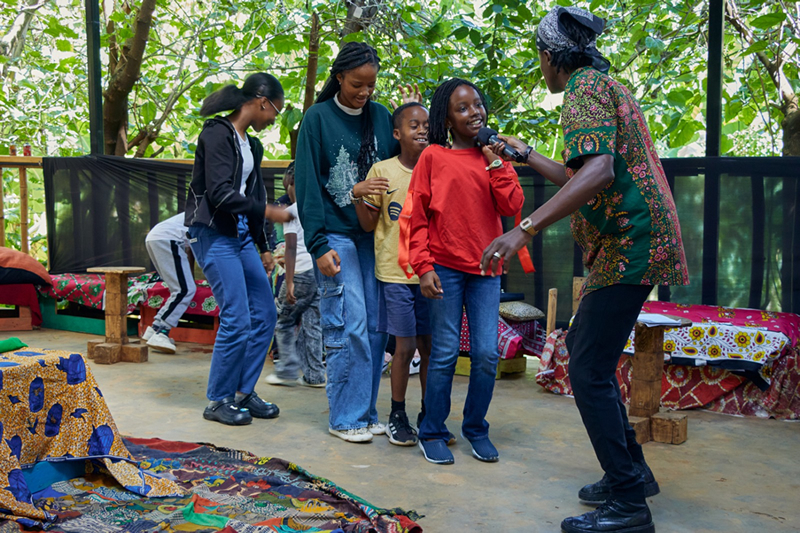
Participants going through their paces at an Applied Theatre Training in Nairobi, organised by Vitalis Waweru.
The nominees for the 5th edition of Kenya Theatre Awards (KTA) were unveiled on the 29th of January 2026 and the awards ceremony will be held on the 26th of February 2026 at Kenya National Theatre. Although the jury watched more performances in 2025 as compared to 2024 there was a drop in the number of categories to be awarded. There were 36 categories in the 4th edition but the 5th edition has 29 categories that the public has been voting for in the open voting lines. This is a huge indictment on the industry as some of the biggest and most popular categories shelved include Best Musical Production, Best actors in musical production (male and female), Best Learning Institution(this is normally reserved for colleges) and Best standup comedy show. It is also good to note that another reason given why the categories had to be shelved are that some categories did not have enough entries and would therefore be unfair to enter one production to compete against itself. Some producers had also requested for reasons best known to them, not to be included in the awards. This means that their teams bear the brunt of that decision and none can be nominated despite outstanding performances in their respective categories.
One reason not mentioned but is actually worth attention is the effect of emerging theatre trends in the industry. More upcoming producers are breaking away from traditional forms of theatre production and experimenting with new forms of. This experimental theatre is not recognized by the Kenya Theatre Awards as it is still practiced by a few individuals. Among these new or previously unexplored forms of theatre were Digital Theatre by Alacoque Ntome, Applied Theatre by Vitalis Waweru and Street Theatre by Thuita Mwangi.
Digital Theatre was pioneered by I AM, a theatrical performance created by Alacoque Ntome. I AM has previously won awards at the Kenya Theatre Awards so it was not eligible for participation again. This show, is heavily investing in augmented reality. It seeks to have actors to do less on stage while giving the audience a wider experience through projected two dimensional silhouettes and voice. This work attracted funding from an organization and was able to tour the country in 2025. However, it is yet to be embraced by other producers. Alacoque calls this type of show “Digital Theatre”. It involves serious pre-production in audio visual studios. The biggest challenge for him has been limited funding to push the show to its full capacity and also lack of experienced and dedicated technical directors well versed in augmented reality. “Practitioners need to be properly educated on the technical elements of production to handle these kinds of shows”, Alacoque says. He has also only managed to produce that one show as it takes a lot of resources and time to create. He is presently collaborating with a local university to push this form of theatre to the next level.
Another form of theatre that is yet to make its mark on the Kenyan theatre scene is Applied Theatre. Other versions of this have been used extensively in the communities and labeled as either TFD(theatre for development) or TFE(Theatre for education). Applied theatre as produced last year by Vitalis Waweru is yet to replicated or embraced in Kenya. Vitalis, who has since completed his studies in Applied Theatre decided to delve deeper into Applied Theatre by being the first to produce a fully fledged production without donor backing. He engaged the services of two professionals to help him stage this production. The two, Thuita Mwangi and Brian Irungu worked hard to bring this to life. The marketing and publicity for this show was not done in the conventional way. The show was not open to the general public maybe out of fear because the Kenyan audience is known to be unforgiving when it comes to unfamiliar theatrical works. Communication was shared with a handful of industry players and friends and families of Vitalis, Thuita and Irungu. Tash Mitambo, a theatre producer and director was among those who attended the show He explained his experience this way: “This was a whole day event held at a serene venue a few kilometers away from the central business district where most theatre goers attend shows. The whole space was the stage and Irungu, an award winning production designer had set up a great theme for the show. The setting was a traditional African home. Thuita, also an award winning performer took charge as the lead facilitator. Using his storytelling skills he introduced topics and raised questions that the audience participated in by telling their own experiences. There were breaks in between where everyone enjoyed refreshments made the traditional way. Irungu also led the audience in games and team building activities as part of the program. This was really good as the audience comprised of people from all ages. What started at around noon ended with darkness setting. Maybe future productions would consider proper time management.
These are kinds of shows that you cannot pull a big audience as Kenyans are used to watching shorter performances. Although the audience clearly enjoyed, this type of theatre needs to be more refined for it to be embraced by the audience and more producers. A lot of work has to be done on the script. Most of the content seemed to be created on the go and for a person who believes in rehearsals, it certainly appeared random and under rehearsed. Future productions should consider a more serious approach in pre-production. The choice of venue was also a bit tricky for the audience especially since most of us rely on public transport. A more central venue would work well for the audience. There was little done after the production to talk about the show either online or in artistic spaces by the producers hence it still remains an experience that most people know nothing about. As an investment is this model sustainable for commercial theatre? A lot of resources were spent in this but no tickets were sold, everyone attended free of charge.” We hope Vitalis has something up his sleeves for Applied Theatre in Kenya in 2026.
Thuita Mwangi also a practicing thespian is also producing a new type of theatre known as “Theatre kwa streets”. Theatre Kwa Streets by itself is a form of applied theatre. Thuita introduced this style in 2024. The audience, mainly those interested in knowing the city more is taken through a tour of the central business district of Nairobi. In every stop, Thuita tells the stories on the significance of the spots to the Kenyan history. As the audience walks through the streets, Thuita acts as a tour guide. For about three hours, the audience gets to enjoy the stories through the streets. This cannot accommodate big audiences and so it has to be strictly via booking to get the few spots available. Security is also a challenge as there are sections of the city Thuita cannot venture with his audience. So far the production has been constrained to uptown because venturing downtown requires more elaborate security arrangements. Special licenses from the city government are also required for these activities. In Kenya where theatre is not directly supported by the government, Theatre on the streets is seen as a high risk investment with low returns. This explains why for a long time it has remained the preserve of Thuita. Although he won an award for this in the 4th edition of KTA, it might be difficult to have a category for theatre in the streets in future editions of KTA since no other producer is willing to take it up.
There is a silent uprising in the industry as thespians try out new forms of theatre to attract the ever dynamic Kenyan audience while making their marks in the books of Kenyan theatre.