MADD, MADD WORLD! Exclusive Interview With Paul Kelemba
By: ADMIN
23/02/2026
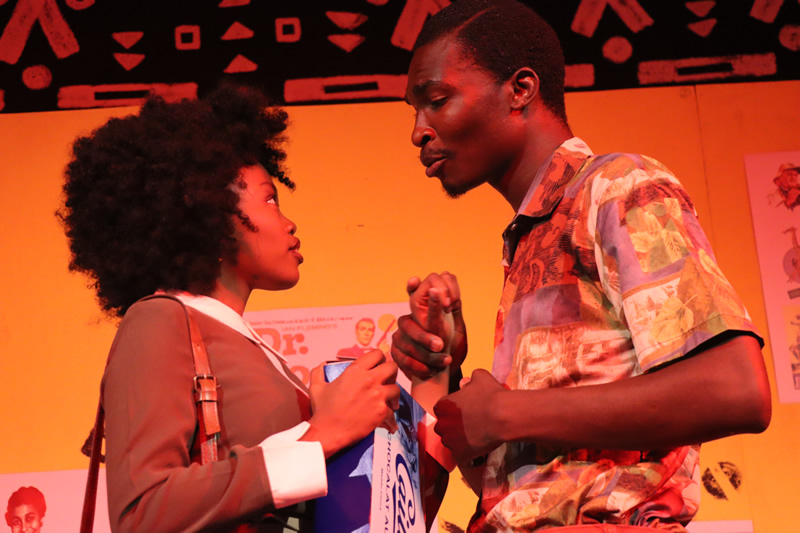
A scene from ‘African Twist’, written by Paul Kelemba, produced by Tabu Osusa and directed by Martin Kigondu.
(Photo: Steenie Njoroge)
Paul Kelemba writes and illustrates the 35-year-old weekly full-page composite cartoon feature It’s a Madd, Madd World under the penname of Maddo. It is a satirical look at politics, society, culture and the arts in The Saturday Standard of Kenya. Born in Nairobi in 1962, he has worked for various publications as a cartoonist and illustrator, including The Daily Nation,along with several other publications and periodicals. He generates IEC materials for UN agencies’ reforms programs, civil society organizations as well as short, themed comics on behalf of Cartoon Movement, among others. He wrote and illustrated Miguel Sede, a popular action hero comic strip for The Sunday Standard in the 1990s. The compilation, It’s a Madd, Madd World 2007-2011; The Hot Years was published in 2012. He is a founding member of Ketebul Music which researches, documents and archives East African music genres. He also sits on the board at Buni Media Limited, a television content producer, and has hosted the retrospective music program Maddo’s Goldies on KBC Radio’s English Service.
The artist has received several awards, among them: Kenya@50 Heroes Award: Outstanding Contribution to Kenya’s History (Kenyatta University, 2013), The CNN Multichoice African Journalist Awards (GE Energy & Infrastructure Category, 2015), The Chevalier de L’Ordre des Arts et des Lettres (Order of the Knight of Arts and Letters, French Government, 2022) and The Lifetime Contribution in Journalism Award(Media Council of Kenya, 2022). He is a Bellagio Center Residency alumnus.
The African Griot Review caught up with him on Opening Day of his hit musical play, African Twist,and secured the following interview…
African Griot Review: What, or whom, inspired you to start drawing cartoons?
Paul Kelemba:My art is inborn, coming from a family of creatives. However, of course, one needs the guidance of established artists to cultivate their own style. I read lots of kids’ comics from the Global North, along with what was available from the development of our region’s comics and still art which was pretty nascent in my youth.
The comics included Beano, Dandy, Topper, Richie Rich and others. They were supplied by my father and older siblings, all fervent consumers of comics. What really captured my attention was Mad Magazine of New York - whose print run has sadly come to an end after decades, though publication continues online. Another comic that nurtured my art was Modesty Blaise written by Peter O’Donnell and illustrated by the Spanish artist Romero. I also owe a lot to the creator of the character Lance Spearman of the 1970s South African photo-comics series Film. His name was Jim Bailey. Locally, I admired the comic strip JuhaKalulu by Edward Gitau. The artist who was to help develop my skills in production of editorial cartoons was Terry Hirst who was behind the Hirst on Friday cartoon and PichaHadithi Comics series.
I started off developing comics – not exactly cartoons - my characters were real life before switching to cartoons thanks to former Fleet Street journalist Brian Tetley who also encouraged me to use a pen name (hence Maddo).
AGR: Can you remember the first cartoon you drew and how old you were at the time?
PK:I wouldn’t really remember my first cartoon. I drew throughout my early school years (much to the chagrin of some teachers). But I recall one cartoon – or illustration as it were – depicting a man in deep thought. I sent it to the children’s magazine Rainbow which was edited by Fleur Ngweno, wife to Weekly Review publisher Hilary Ngweno. She published it and I gained early ‘celeb’ status in school; the year was 1977. I was 14 and in Form One.
AGR: Your body of work as a cartoonist is impressive and your style very unique. I can tell a Maddo cartoon in a newspaper just by looking at it. Did you get any formal education in fine arts or illustrations at any point of your career?
PK:No. As I’ve mentioned, my endowment is congenital. But that alone won’t turn one into an accomplished artist without influence from the world. Education in fine arts refines one. Unfortunately for me, all the schools I attended, beside kindergarten and lower primary, did not offer art classes. In my self-training, I studied the work of various artists in order to develop my own and eventually foster a distinct, individual style. Let me mention that, we early African media artists, heavily influenced by characters from the West, tended to lean towards Caucasian features in the characters we generated. It was a struggle to wean ourselves off that and appreciate African values in our artwork.
I work today with many young artists who have graduated from institutions offering art. One can observe that, despite natural creativity, school enhances one’s discipline in one’s career. Somehow, along with a good number of others, I escaped that avenue to gain eventual recognition. Actually, there are countless artists who are self-taught strewn across history.
AGR: At one point you had a graphic-novel-esque series called Miguel Sede in a local newspaper. What happened to this initiative or is it continuing in a comic book somewhere?
PK:Miguel Sede was an action hero that I developed with stimulation from Modesty Blaise and her partner in fighting crime, Willy Garvin. I am a story teller, really, and did try my hand at writing fiction in my teenage. The values that I hold in life helped build the Sede character – an investigative journalist who went beyond filing reports on corruption and crime to physically dismantling evil networks. He was a retired military man and a combat specialist.
The comic feature was published throughout the 1990s by The Standard newspaper. It was discontinued in 2001 for reasons I can only disclose in my biography. You must pardon me. I intend to publish the series someday soon especially that, with today’s digital spaces, publishing is a lot simpler than it was a couple of decades ago. And, yes, we did make an attempt to have Sede make a comeback, written by Edward Gakuya and illustrated by Maurice Odede. A later-day version that would appeal to the current audiences.
AGR: You’ve had a very long career. Apart from newspapers, where else has your work appeared, locally or abroad?
PK: Well, yes, it’s been a stretch. My composite cartoon featureIt’s a Madd, Madd World is entering its 36th year. My career spans four decades. My work has been exhibited in Finland, Germany and Tanzania. I have attended forums by virtue of my work in Japan, Italy, Estonia, Tanzania and elsewhere.Besides producing cartoons for print media, I am a board member at Buni Media - this is a television content provider. I belong to the music research outfit Ketebul Music as well.
AGR: In 2025, you made a surprise entry into the world of theatre as the playwright behind African Twist: The Soundtrack of Kenya’s Independence. How did this musical project come about and what was your role in it?
PK:As I’ve indicated, I did try my hand at writing as young dude. I have always aspired to write some fiction account, either a book or a stage play, but drawing cartoons became my mainstay. I should stress that I can never compare myself to accomplished playwrights. But I have had a tremendous interest in theatre – in fact many close friends of mine belong to this trade. I have been able to watch countless plays giving me the opportunity to study their composition and delivery.
I joined Ketebul Music at its inception in 2007. The institution carries out research on indigenous music genres of Eastern Africa and we have published a number of documentaries and books. One of the areas of our study is Kenya’s early music development. As such, under its founder, music producer Tabu Osusa, we have examined the lives, careers, music styles and inspirations of various musicians, music producers, audiences and mediums.
With the rapidly evolving social scene in Kenya, young people are beginning to raise questions about their history with answers that are not forthcoming from their political leaders, teachers and parents. The young generation – the now famous GenZ – are known for impatience in consumption of historical information, preferring brief, exciting, yet explanatory narratives, to devour historical data.
Tabu and I thought it would be a great service to present an aspect of Kenya’s sociopolitical history through visuals. Having produced documentaries, text articles and even hosted live music concerts with specific themes, we settled on a play, drawing from the vast research and archive we have built. Tabu is an author in his own right but we elected that I generate the script based on my knowledge in storyboarding comics which involve a series of speech balloons – an outright dialogue progression not commonly thought of as such. We wanted a unique storyline as well. We write music stuff, but this wouldn’t be enough. So, we tossed in politics, crime and romance against the background of a young, emerging nation full of hope after colonization. The spine was, of course, twist music. Our director, Martin Kigondu, played a huge role in the overall presentation.
It is this combination that, perhaps, drew curious audiences. The young came to find out what exactly this twist thing was, what story could be told about the ‘ancient’ dance style and how it resonated with their present trends. The old came for purely nostalgic purposes. We sought to employ the area we are strong in; live music. We incorporated three professional instrumentalists to back the cast. It was a young cast that corresponded with the average age of the real-life individuals we were featuring. We were at pains to remind reviewers that this was not a musical (which we couldn’t have managed at the time) but rather just a play… with live music.
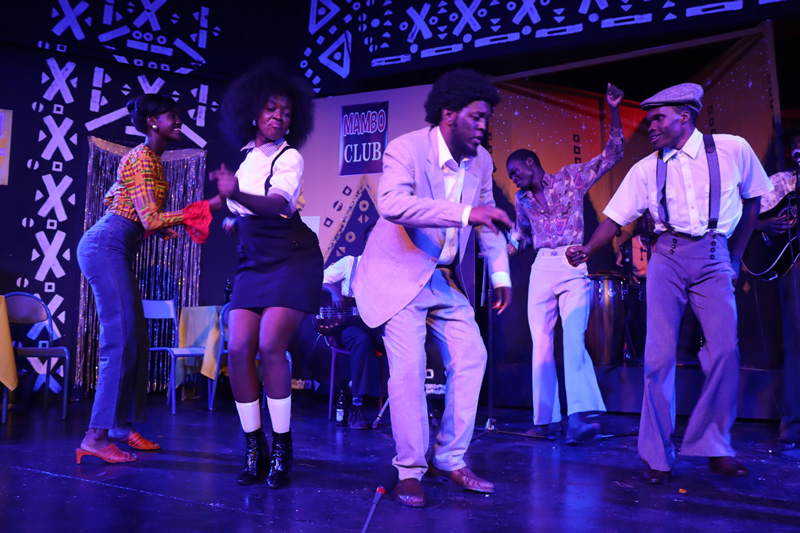
A scene from ‘African Twist’ which debuted at the Alliance Française de Nairobi. (Photo: Steenie Njoroge)
AGR: The attendance and reviews for African Twist, during its premier at the Alliance Française de Nairobi were great. Are there any plans to showcase the play in other parts of the country or even abroad?
PK:We were honestly, pleasantly surprised by the turnout. After the premiere night, which was in tandem with a diplomatic event, the show registered house full runs with video stream overflows. Yes, Ketebul Music is looking at the possibilities of a re-run or two, in Nairobi and a down or upcountry town. Abroad? No… not now. That’s something many dream of. Perhaps, when we have proven ourselves and enhanced the presentation, we could begin to imagine that. I wouldn’t rule it out. Right now, we shall play within our league.
AGR: Do you intend to continue writing plays, or being otherwise involved in live theatre?
PK:It’s not a bad idea. The subject of music, politics and society is vast with fathomless aspects of potentially awesome, dramatized chronicles. Yes, I intend to write another play with a not too dissimilar theme. Live theatre will remain traditional for a very long time as other sectors in art and culture take on different paths.
AGR: As the title of your long-running graphic journalism column suggests, “It’s a Madd, Madd World”, what are some of the craziest reactions or threats you have received for your caricatures over the years?
PK:Well, that’s quite a long story. In a cocoon, there have been several incidents of intimidation in this perilous work in a country with successive regimes hostile to and bent on muzzling freedom of speech, media space, dissent and critics. I did my part in the journey to Kenya’s Second Liberation in the early 1990s through my cartoon commentary and work with civil society. Phone calls were made, direct threats were issued and later email was used to deliver messages from those not happy with what I was doing. I came out rattled but unscathed.
The promise of the law being upheld and the right to publish divergent opinions respected, as offered by the 2010 Constitution, is now evidently short lived. The country is experiencing a slide back to the era of a system that does not believe in anything outside itself. This is a package that consists of a ruthless leader who desires absolute power and parroting lieutenants. In recent times, the horizon is beginning to look even gloomier with government intolerance to social media.
There have been lots of awesome moments as well in my career. A number of my cartoons have been well received with wide acclaim.
AGR: Artificial Intelligence is where it is at nowadays. Have you paid any attention to its encroachment in your field of graphics and cartoons, and do you think it’s going to be a blessing or a curse in your profession?
PK:I and my colleagues have welcomed this new stride in how images are generated and disseminated. AI is a powerful tool that we must embrace just like we have done every step in technological advances over the past century. Employed well, it works well. It has lessened the work load we have. Remember, drawing pictures is a laborious process. Even PhotoShop was regarded as a threat by ‘traditionalists’ but eventually accepted.
The downside of Artificial Intelligence is the laziness it has introduced in creativity. I always contend that digital tools should supplement our output and not take over our ability to think, ability to create. The other negative is, of course, one’s ability today to generate misleading images and context. With traditional tools, it was an uphill task to mold a fake that would fool audiences. Right now, it is almost impossible to distinguish between faux and vérité. However, the human brain has survived millennia of scientific innovation and is not about to fade away.